A running collection of the things that don't fit in a guidebook — the bits of language, history, religion and daily life that only make sense once you're standing in them.
Anything you notice, read, or get told by a guide — send it over in whatever shape it arrives, a sentence or a photo of a sign. It gets written up here, filed under the right country, and cross-referenced with the rest of the site if it belongs somewhere else too. The entries below are the ones we started with.
Nepal
A Hindu-majority republic with a deeply Buddhist valley at its heart, and a calendar, a clock and a set of gods that all run on their own logic.
Time & calendar
Nepal is 5 hours and 45 minutes ahead of UTC, and the year is 2083
Nepal is one of only three places on earth, and the only sovereign country, using a 45-minute offset. Kathmandu's true solar time is UTC+5:41:16, and rather than round to the half-hour the country set its clock to the meridian running through Gaurishankar, a sacred peak about 100 km east of the city — which works out at exactly +5:45.
The arithmetic is only half the story. From 1920 until 1986 Nepal ran on India's +5:30, and the decision to advance the clocks by fifteen minutes was a quiet statement of sovereignty by a country wedged between two giants: its time now belongs to neither neighbour.
The official calendar is Bikram Sambat, about 56 years and 8 months ahead of the Gregorian one — late 2026 is 2083 BS. Newspapers, government paperwork and most shop signs use it, so a date on a permit may not look like the date you expect.
everydaypaperwork
Religion
The living goddess is a real child with a civil service around her
The Kumari is a pre-pubescent girl from the Newar Shakya caste, selected against a list of physical perfections and a demonstrated lack of fear, who is worshipped as the earthly manifestation of the goddess Taleju until she menstruates. She lives in the Kumari Ghar on Kathmandu Durbar Square, appears at a window for visitors, and is carried in procession at Indra Jatra. There are several Kumaris in the valley — Patan and Bhaktapur have their own — and former Kumaris receive a state pension.
KathmanduIndra Jatra
Peoples
"Sherpa" is an ethnic group, not a job
The Sherpa are a Tibetan-descended people of the Solukhumbu, around 150,000 strong, with their own language and a Nyingma Buddhist tradition. Calling any porter a sherpa is a bit like calling every plumber a Fleming. On the Annapurna side you are far more likely to be walking through Gurung and Magar country — Gurung villages like Siding and Lwang, with their slate roofs and a strong tradition of service in the British and Indian Gurkha regiments.
Annapurnalanguage
Architecture
The valley's towns were three rival kingdoms
Kathmandu, Patan and Bhaktapur each had their own king, their own Durbar Square and their own court artists, and spent centuries competing in architecture. That is why three royal squares sit within eight miles of each other, and why each has a different character: Kathmandu's is the most built-over, Patan's the most refined, Bhaktapur's the best preserved. The unifying culture is Newar — the valley's indigenous people, whose craftsmen exported the pagoda form to Tibet and China.
PatanBhaktapur
The week
Saturday is the weekend, and Sunday is a working day
The Nepali week runs Sunday to Friday, and Saturday — Sanibar — is the single day of rest. It is dedicated to Shani, the planet Saturn, held to be a powerful and difficult force, so tradition avoids starting new work, making major purchases or beginning long journeys, and turns instead to rest and appeasement. It is the busiest morning of the week at any local shrine, with families offering tika, flowers and food.
Practically, this catches visitors out: government offices and the trekking-permit counters are shut on Saturdays, while Thamel and Lakeside carry on regardless. Step into a residential neighbourhood on a Saturday and the difference is obvious. See also Religion.
everydayplanningHindu
Festivals
Indra Jatra: a pole, three chariots, a demon and a mask that serves beer
Kathmandu's biggest street festival marks the end of the monsoon and honours Indra, the Hindu god of rain, while also celebrating the Kumari. Four things make it:
The Yosin — a massive ceremonial pine pole raised in Durbar Square to open the festival, representing Indra's banner. The Kumari Jatra — three heavy wooden chariots dragged through the old city by hundreds of young men, the main one carrying the Living Goddess and the others boys representing Bhairab and Ganesh; one of the few times a year the Kumari leaves her palace. The Majipa Lakhey — a dancer in a terrifying red demon mask with wild hair who, in Newar folklore, is a protector of the city's children; you hear the drums before you see him. And Sweta Bhairab, a huge mask of Shiva's fierce form kept hidden behind a wooden lattice all year, from whose mouth rice beer is poured during the festival while crowds scramble for a sip.
KathmanduSeptemberNewar
Politics
The government fell in two days, and the country is now run by a former rapper
In September 2025 the government banned 26 social media platforms, citing regulatory non-compliance. To a generation facing youth unemployment above 20%, an economy dependent on remittances and decades of entrenched corruption, it read as censorship. Protests organised largely on Discord, leaderless and overwhelmingly Gen Z, began on 8 September and escalated within a day into the worst political violence in modern Nepali history: parliament, Singha Durbar and the presidential residence were set alight, police used live ammunition, and around 74–76 people died with more than 2,000 injured. The army imposed a nationwide curfew.
Prime Minister K. P. Sharma Oli resigned on 9 September. On the 12th, former Chief Justice Sushila Karki was appointed interim prime minister — the country's first woman head of government — parliament was dissolved, and elections set for 5 March 2026. The Rastriya Swatantra Party took 182 of 275 seats, and Balendra "Balen" Shah, the rapper-turned-mayor of Kathmandu, was sworn in as prime minister on 27 March 2026.
Worth knowing before anyone asks your opinion of it. The burnt-out government buildings are still visible in central Kathmandu.
politics2025Kathmandu
Festivals
What Dashain is actually about
Dashain celebrates good over evil. In the myth, a demon named Mahishasura — who could shape-shift into a water buffalo — terrorised the world, and the gods, powerless alone, combined their energies to create the fierce multi-armed warrior goddess Durga. The festival honours her nine-day battle and her killing of the demon on the tenth day.
Because Durga represents martial energy, tradition holds she must be appeased with blood. The sacrifices peak on Maha Ashtami and Maha Navami, around 18–20 October in 2026, at temples and military garrisons nationwide and most publicly at Hanuman Dhoka. Water buffalo feature especially, standing in for the demon. The meat is not wasted — it goes home to the family feast. The practice is increasingly debated in Nepal, with a growing number of younger Nepalis and animal-rights campaigners arguing for symbolic substitutes: a coconut, a pumpkin, an ash gourd.
OctoberHinduDurga
Space for the next one
Language quirks, food you can't identify, something a guide explains at a temple, why the houses in one valley are painted differently from the next — send it over and it lands here.
Bhutan
A Vajrayana Buddhist kingdom that opened to tourism in 1974, measures its progress in happiness, and has never been colonised.
The name
Bhutan does not call itself Bhutan
The Bhutanese name is Druk Yul — the Land of the Thunder Dragon — and the people are Drukpa. The dragon on the flag clutches jewels, representing wealth, and its snarling mouth represents the strength of the deities protecting the country. "Bhutan" is an outside name, probably from Sanskrit Bhoṭa-anta, "the end of Tibet".
languageeveryday
Government
The king gave away his own power, and had to insist
Bhutan became a constitutional democracy in 2008 not through revolution but because the fourth king, Jigme Singye Wangchuck, spent years pushing a reluctant population towards it, then abdicated in 2006 in favour of his son to make the transition stick. The same king coined Gross National Happiness in the 1970s. It is now a measured framework with nine domains and a national survey, used to screen policy — proposals are assessed for their happiness impact much as other countries assess environmental impact.
politicsGNH
Architecture
Dzongs were built without nails, and without drawings
The great fortress-monasteries — Punakha, Paro Rinpung, Trongsa — are timber and rammed earth, assembled with interlocking joinery rather than nails, and traditionally built without architectural plans: a lama would determine the layout by inspiration and the master carpenter would work from it. Each dzong still houses both the district administration and the monk body, in separate courtyards, which is why you are visiting a government office and a temple in the same building.
dzongsPunakha
Daily life
The national dress is a legal requirement, and has a pocket the size of a rucksack
Men wear the gho, a knee-length robe folded and belted to create an enormous chest pouch that historically carried a bowl, a knife and betel nut, and now carries a phone and paperwork. Women wear the kira, an ankle-length wrapped cloth. Both are required in dzongs, schools and government offices, along with a ceremonial scarf whose colour marks rank: white for ordinary citizens, saffron for the king and the Je Khenpo.
etiquettedress
Nature · 2 June
A country that plants trees to celebrate its kings
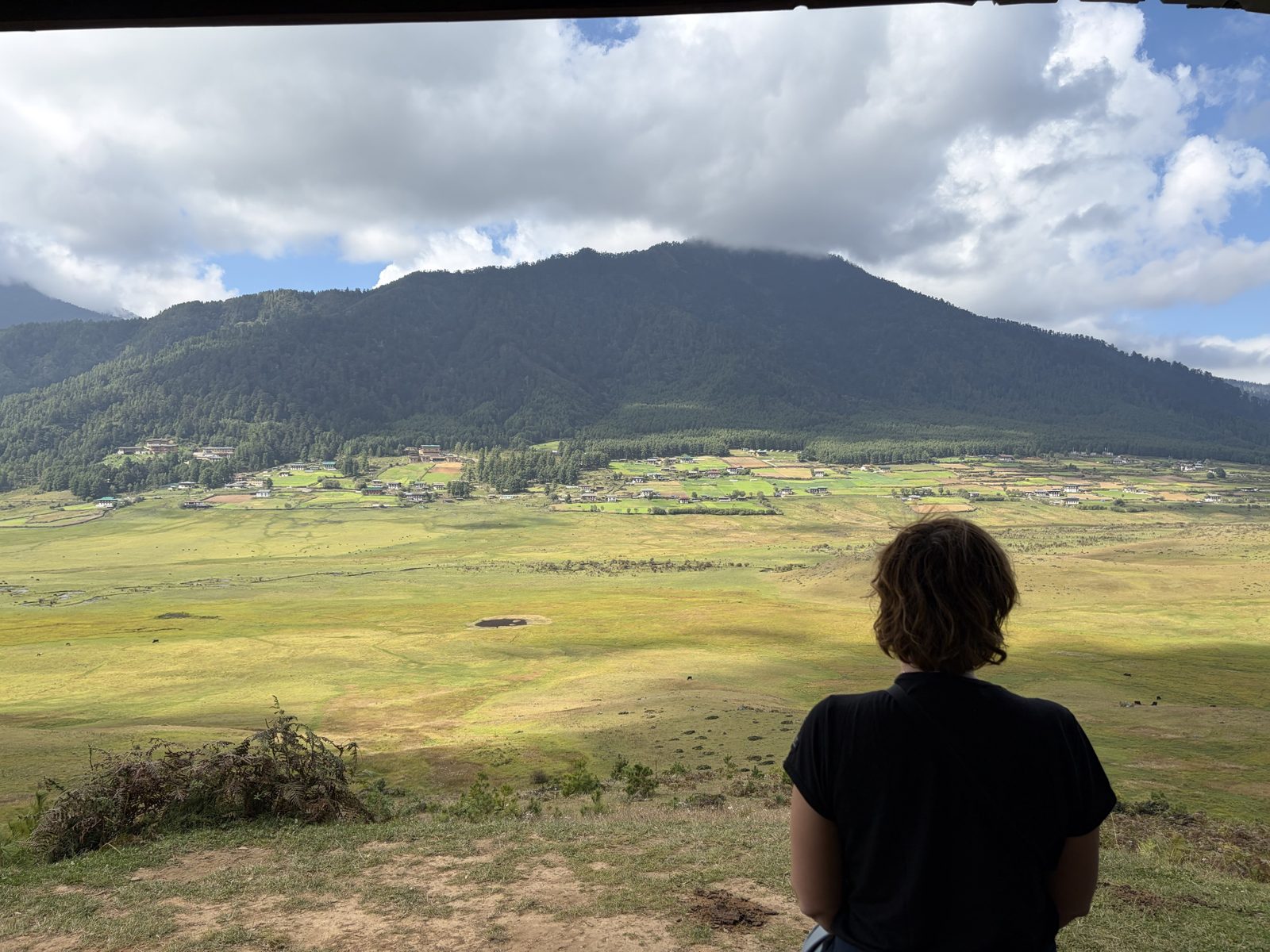
The Phobjikha valley, winter home of the black-necked cranes — still full of cows in October; the cranes come later.
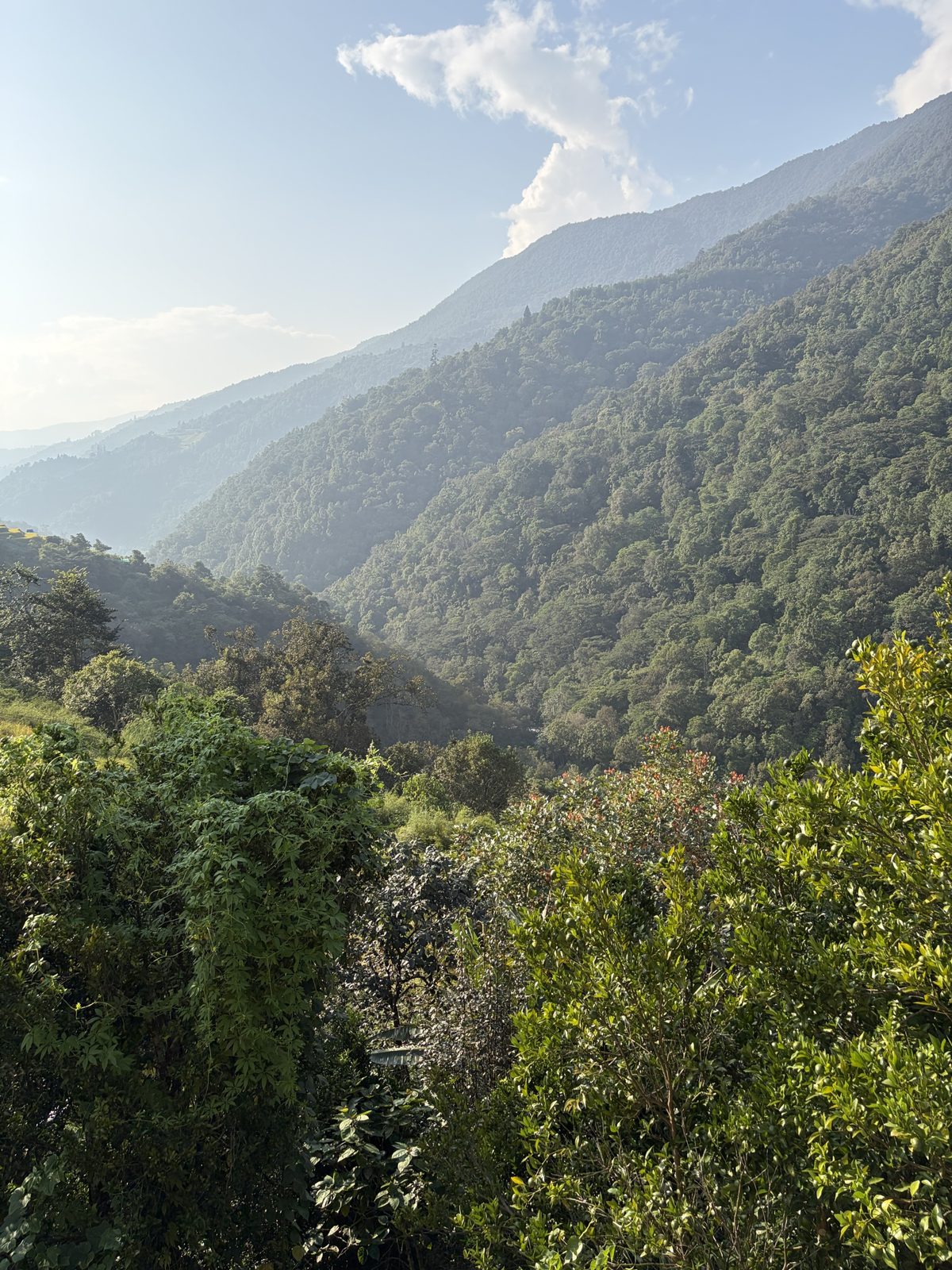
The first thing you notice in Bhutan is how green it all is: forest right up to the ridgelines, valleys without a bare slope, and even a wide glacial valley like Phobjikha that looks like a piece of untouched grassland with a few farms in it. That isn't chance but policy. The 2008 constitution requires that at least 60 per cent of the country remain forested for all time; in practice it's about 70 per cent. Exporting raw timber has been banned since 1999, and the country would rather earn its money from hydropower out of those same forested valleys.
Forest to the ridgeline: this is what most of Bhutan looks like.
Every year on 2 June it's Social Forestry Day, the national tree-planting day. The date was chosen because the Fourth King, the man behind Gross National Happiness, was crowned on 2 June 1974: instead of a parade, the whole country plants trees. Schools, villages, monks and ministries all turn out. In 2015 a hundred volunteers planted 49,672 saplings in a single hour, a world record. When the crown prince was born in 2016, Bhutanese planted 108,000 — 108, the sacred number — each with a wish for a long life.
The result is one of the very few carbon-negative countries in the world: its forests absorb more CO₂ than the whole country emits. And Phobjikha shows how far it goes. When the valley finally got electricity in 2013, the cables were laid underground, so the black-necked cranes that fly in from Tibet from late October to spend the winter wouldn't injure themselves on power lines.
natureforestPhobjikha
Space for the next one
Whatever the guide tells you that isn't in any book — a local legend, why a particular temple is where it is, what people actually think about the tourist tax.
How to add one
No format needed. A voice note, a half-remembered fact, a photo of an information board, "the guide said something about why the bridges have those chains" — all fine. Each entry gets a category, a headline, a short write-up, and tags so related things can be found together.
If something you notice contradicts what's already on the Practical or Tips pages, say so — those pages get corrected rather than left standing.